
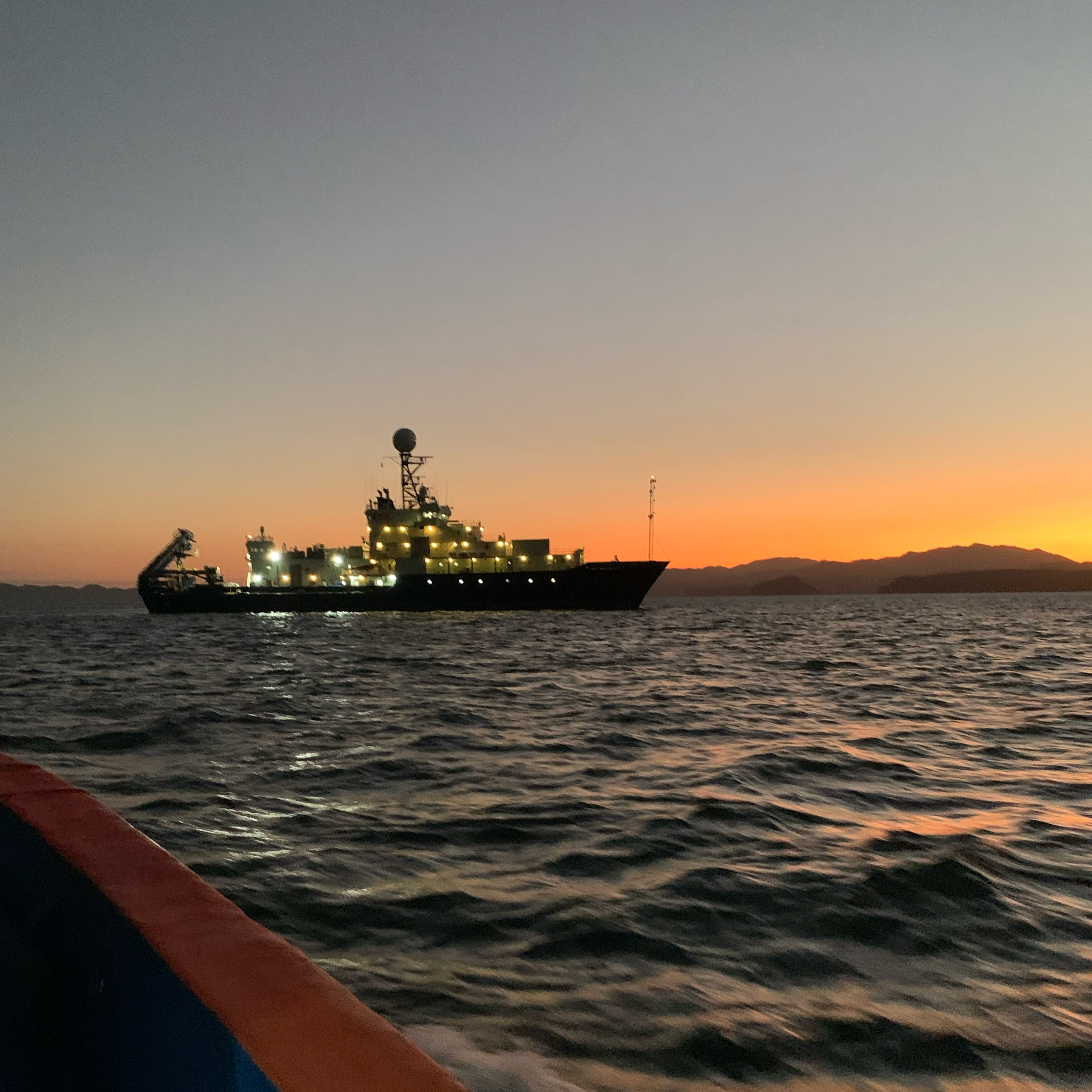
Boarding Atlantis
Posted on February 6, 2023 • 4 minutes • 770 words
About a year ago, my friend and collaborator, Maria, approached me about joining a research cruise she was leading to the Eastern Tropical North Pacific oxygen minimum zone. She was leading a very comprehensive project looking at microbe-driven biogeochemical processes, and wanted to add a virus component to the project. She was wondering if I could be the person to make that happen.
I’d recently returned to work after maternity leave, and with a infant at home, my immediate reaction was, “I can’t.” But after sitting on the idea, and thinking about the science that could be had on such an adventure, my thinking slowly turned from “can’t” to “why not?”. I was in the process of applying for a Research Scientist position at my institution at the time, and the promotion would come with a small startup that could cover my salary. Maria said she could pay for the needed supplies if I could just get myself there. With this cruise, and the data Maria planned to collect, I also saw an opportunity to carry out some really cool and comprehensive studies on the activity of viruses in oxygen minimum zones by collecting a relatively small amount of additional data.
And so the planning began. My new position as a Research Scientist started in July, and right away I wrote a grant proposal. I wasn’t going to have time to get it funded before the trip, so instead I proposed leveraging the data collected by Maria’s team with additional samples that I planned to collect, and focused on what I would do with all of the data created from this expedition in the following years. The proposal became the foundation for the sampling I would be doing aboard the ship, and set a roadmap for preparations prior to the cruise. From there, there were lists of supplies and reagents, and inquiries to colleagues about what equipment I could borrow from them to carry out the research I intended to do. In November, I hauled the collected equipment and supplies down to Woods Hole, where it joined Maria’s and other’s to be placed on the ship while it was in port on the Eastern US coast.
In parallel to the science planning, I faced the reality that I would have to leave my spouse and kids at home. I’ve got two young girls, 1 and 3 years old. The one year old is like a happy little drunk person right now, living entirely in the moment. She loves her Mama, as all 1 year olds do, and she wasn’t going to be able to understand that Mama was gone, or if or when I would come back. The three year old was another story. She is sharp, she gets it. I had to prep her, talk to her about my trip from every angle. Time will tell how she will do while I’m gone, but I’ve tried to give her as much reassurance as I can that Mama will be back. And then, of course, my amazing spouse. He was all in from the moment the opportunity presented itself. He is also a scientist, and had gone on a long trip when our first was 1, so understood how enriching it can be to take time away, and to be immersed in science as one is on research expeditions. We called his mom, ‘Gramma’, and she agreed to come live with them the entire six weeks that I’d be away. All to say, the kids and spouse were going to be fine.
The decision to leave was a hard one, but what convinced me to do it was the example I wanted to set for my girls. I didn’t want to have to tell them years from now that I’d passed up an opportunity to expand my career, to go on an adventure. I’d want them to make a similar decision if they were in my shoes. Yesterday, after a long day of travel, I arrived on the R/V Atlantis, moored off the shore in Puntarenas, Costa Rica. When I climbed aboard, I gave Maria a big hug, excited for this trip, and grateful for the opportunity. Maria had already taped off a bench for me, piled with the equipment I’d dropped off in Woods Hole and all needed supplies to make sampling viruses on this expedition happen. So now it’s just me, on a ship, pursuing my not-quite-funded research with a team of researchers whose collective objective is to map out the microbial processes happening within the Eastern North Tropical Pacific oxygen minimum zone. It’s good to be here.